Plain water gets boring — that’s really the whole problem infused water solves. Before you get to the sixteen combinations below, it’s worth being upfront about how this actually works, because the honest answer is less exciting than most posts about it: cucumber slices and mint leaves don’t rev up your metabolism in any meaningful way. What they do is make water taste good enough that you’ll actually drink more of it, and reach for it instead of something sugary. That’s the entire mechanism — and it’s a genuinely useful one, not a consolation prize.
Search interest in infused water has climbed sharply in 2026, and we don’t think that’s a coincidence: it’s a symptom of plain-water fatigue, not evidence of a hidden fat-burning trick. The trace compounds in these recipes — a little pectin here, a little gingerol there — are real and mildly useful, and we’ll tell you what’s actually known about each one. We batch-prepped all sixteen of these over several weeks to see which ones actually held up in the fridge, which ones were worth the extra five minutes of prep, and which ones we kept remaking on our own — notes on that are sprinkled in below.
This page is also where we’ve collected DrinkFitLab’s hydration content in one place. Below the recipes, you’ll find links out to our deeper dives on exactly how much water you should be drinking, whether water itself does anything for weight loss, and a couple of related drink trends — so treat this as a hub, not just a recipe list.
Does Infused Water Actually Help You Lose Weight?
Infused water — sometimes marketed as “detox water,” a label that oversells it, since your liver and kidneys don’t need fruit slices to do their job — is water steeped with fruit, vegetables, herbs, or spices for anywhere from 30 minutes to 12 hours. Steeping doesn’t meaningfully change the nutritional profile of the water itself; a lemon slice won’t give you a real dose of vitamin C. What it does do is a few things that genuinely matter for weight management:
- It replaces higher-calorie drinks. Swap a 150-calorie soda or juice for infused water at under 10 calories, and you’ve created a straightforward calorie deficit without changing anything else about your day.
- It increases how much water you actually drink. People reliably drink more water when it’s flavored than when it’s plain — and that total volume is what matters. If you’re not sure what a reasonable daily target even looks like, how much water you should actually be drinking to lose weight lays out practical numbers instead of the generic “eight glasses” rule.
- It delivers a small amount of bioactive compounds. Lemon contributes a bit of pectin, a soluble fiber tied to appetite regulation; ginger’s gingerols may offer a mild, short-lived boost to calorie burn; cucumber adds trace antioxidants. None of this is dramatic in isolation, but daily repetition adds up in a way an occasional “detox” cleanse doesn’t.
- It can ease bloating. Mint, basil, and sage have mild carminative (gas-easing) properties that can take the edge off a bloated feeling — not “flush toxins,” just calmer digestion.
The strongest evidence in this whole category isn’t really about the flavor add-ins — it’s about water itself. In a well-known 2010 trial published in Obesity, middle-aged and older adults who drank 500 mL (about 16 oz) of water roughly 30 minutes before meals, on top of a reduced-calorie diet, lost about 4.4 lbs (2 kg) more over 12 weeks than a diet-only comparison group. That effect looks most consistent in older adults specifically — some studies in younger adults haven’t found the same meal-to-meal calorie reduction, so it’s not a universal guarantee. Infused water doesn’t add anything new to that mechanism; it just makes the habit easier to stick with, since a genuinely tasty pitcher in the fridge is easier to reach for than a plain glass. For the fuller picture — including where this research holds up and where it gets oversold — see our evidence-based look at whether drinking water actually helps you lose weight.
How to Make Infused Water: The Base Method
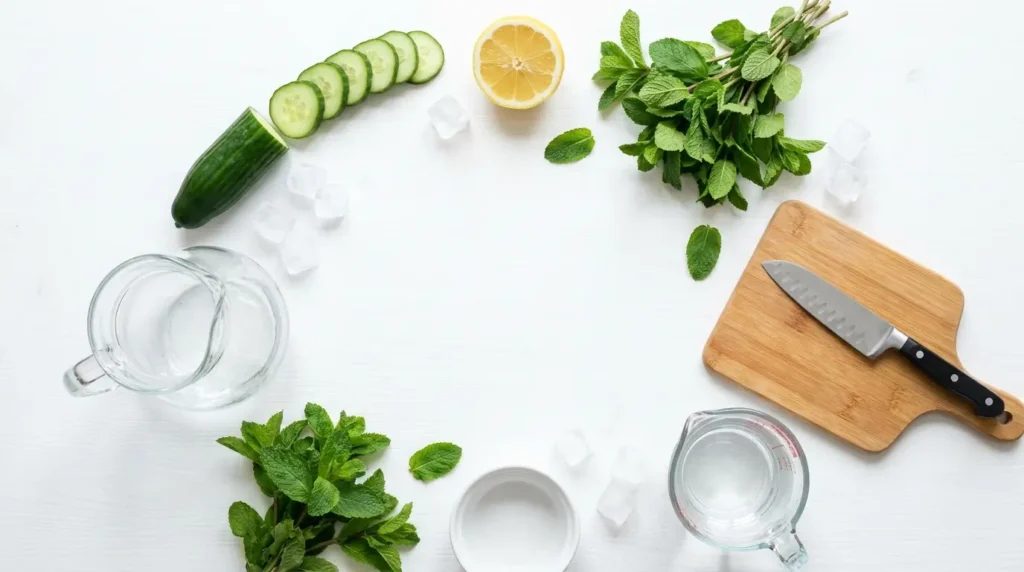
Every recipe below follows the same simple framework.
You need: a 32 oz (1 liter) glass pitcher or BPA-free infuser bottle, filtered water, and your ingredients.
The steps:
- Wash and thinly slice all produce.
- Gently muddle (lightly press) herbs between your palms to release their oils before adding them — this noticeably increases the flavor payoff.
- Add ingredients to your pitcher and fill with filtered water, cold or room temperature.
- Refrigerator infusion (recommended): cover and refrigerate for 2–4 hours minimum, up to 12 hours for maximum flavor. Remove the fruit after 12 hours to keep it from turning bitter.
- Quick infusion: let it sit at room temperature for 30–60 minutes, then add ice.
Yield: each recipe below makes one 32 oz (about 4 cups / ~950 mL) batch. Double the ingredients in a gallon pitcher to batch-prep a week’s worth on Sunday.
Macros baseline (all recipes): Calories 2–10 kcal | Protein 0g | Fat 0g | Net Carbs 0–2g | Sodium 0–5mg
💡 Kitchen tip: Build the pitcher with ingredients visible through the glass, float a few herb leaves on top, and shoot it against a plain light background before you add the water — that’s the shot that actually gets saved and shared.
The 16 Infused Water Recipes for Weight Loss
One of these — the one we get asked about most — is written out below as a full, printable recipe card. The other fifteen are quick versions: same real ingredient amounts and macros, just less scrolling to get through them.
Classic Lemon-Ginger Infused Water
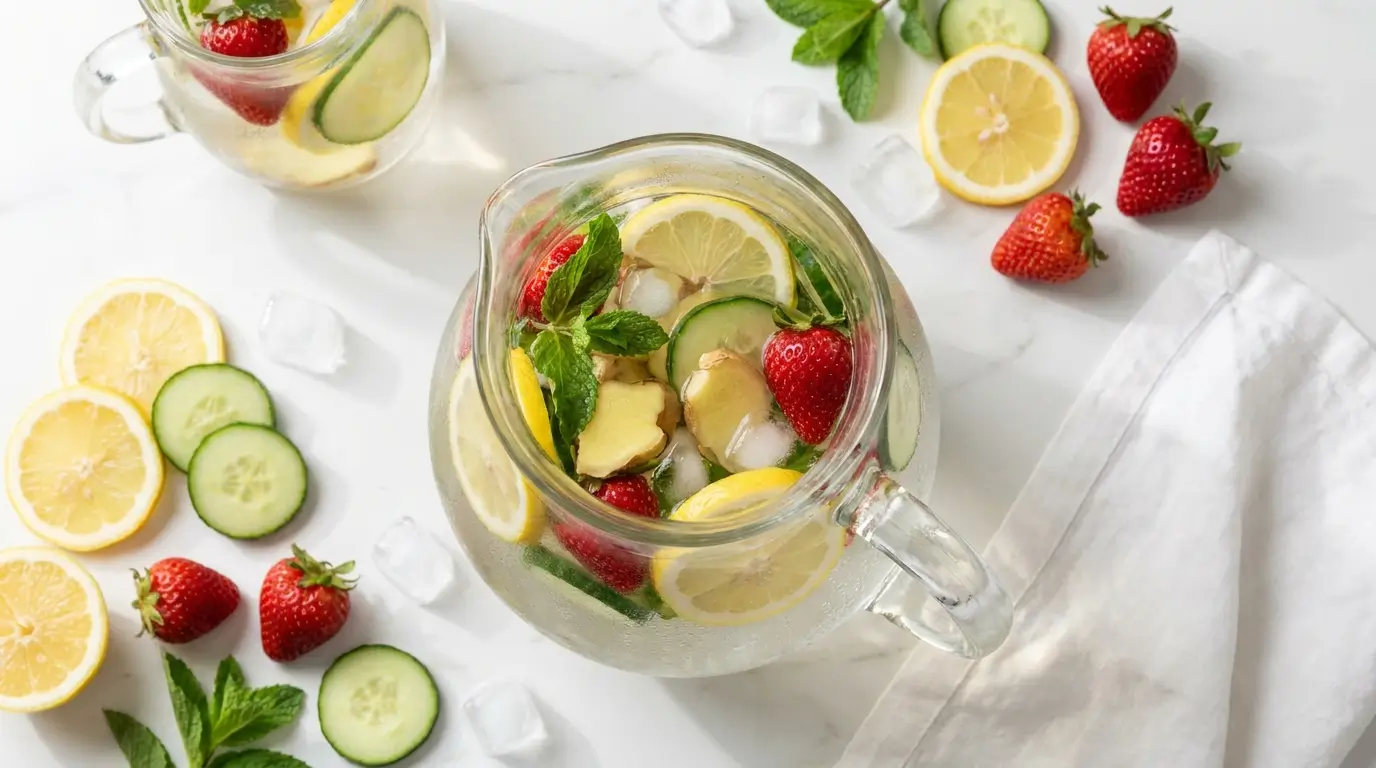
A bright, simple infused water built around the most-studied pairing on our list — lemon and ginger. Batch it on Sunday and sip it about 30 minutes before meals for the best effect.
- Prep Time: 5 minutes
- Cook Time: 2 hours
- Total Time: 2 hours 5 minutes
- Yield: 1 batch (32 oz, about 4 cups) 1x
- Category: Drinks
- Method: No-Cook
- Diet: Low Calorie
Ingredients
- 1 medium lemon, thinly sliced
- 1 inch fresh ginger root, peeled and sliced into coins
- 32 oz cold filtered water
- 2–3 fresh mint leaves (optional)
Instructions
- Add the lemon slices and ginger coins to your pitcher.
- Gently muddle the mint, if using, and add it in.
- Fill with cold water and stir.
- Refrigerate for 2–4 hours before drinking, ideally 30 minutes before meals.
Notes
Pro tip: this is the upgraded version of our 7-day lemon water challenge — the ginger noticeably amplifies the appetite-suppression effect compared to lemon alone.
Nutrition values below are estimates based on standard ingredient sizes and the whole-batch totals from the full article, not a lab analysis.
Nutrition
- Serving Size: 1 batch (32 oz)
- Calories: 5
- Sugar: <1
- Sodium: 3
- Fat: 0
- Saturated Fat: 0
- Unsaturated Fat: 0
- Trans Fat: 0
- Carbohydrates: 1
- Fiber: <1
- Protein: 0
- Cholesterol: 0
2. 🥒 Cucumber-Mint Infused Water
Best for: bloating and that puffy, water-retention feeling
Reach for this one when you feel bloated, not when you’re chasing fat loss — it’s an important distinction, and it won’t do the latter. Cucumber is roughly 96% water with trace cucurbitacins that have mild anti-inflammatory properties, and mint relaxes digestive-tract muscle enough to help move trapped gas along. It’s genuinely good for the bloated feeling; it just isn’t doing anything to body fat.
- ½ medium cucumber, thinly sliced
- 10–12 fresh mint leaves, gently muddled
- 32 oz cold filtered water
- Optional: ½ lime, sliced
How to make it: Layer the cucumber and muddled mint in your pitcher, add lime if using, fill with cold water, and refrigerate at least 2 hours. Best within 24 hours.
32 oz batch · ~3 kcal · ~0.5g carbs · 0g protein/fat · chill 2+ hrs
3. 🍓 Strawberry-Basil Infused Water
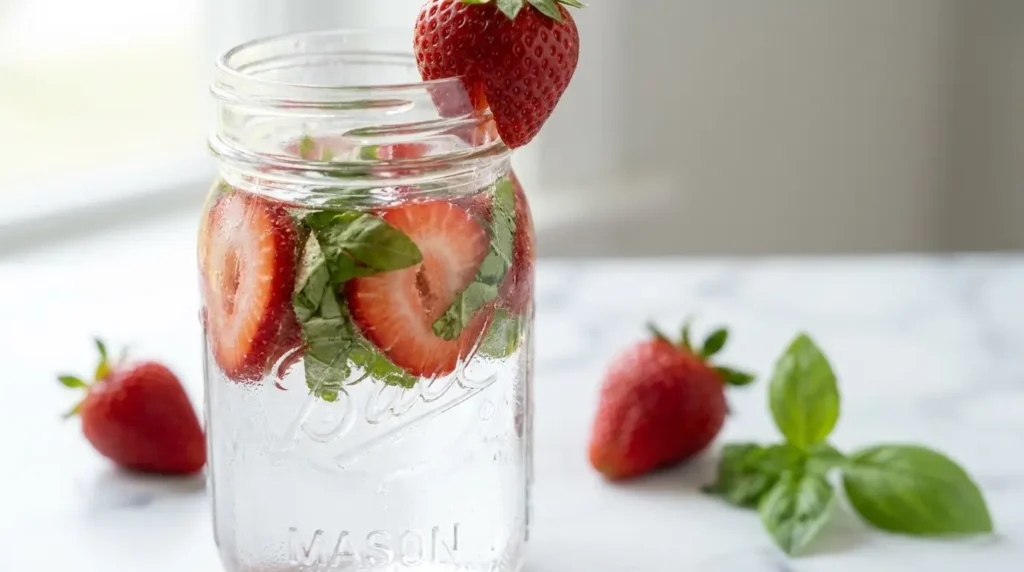
Best for: antioxidant intake, dressed up for the fridge
Strawberries supply fisetin and anthocyanins — polyphenols that have shown promise for fat-cell regulation and insulin sensitivity in animal studies, though human evidence at the tiny doses you’d get from a few berries steeped in water is much thinner. Basil’s linalool and eugenol are genuinely anti-inflammatory compounds. Good flavor, modest but real function — and if you like the bright, photogenic side of this one, our Pink Drink roundup ranks five popular colorful drink recipes by calorie count, for more in that vein.
- 6–8 fresh strawberries, hulled and sliced
- 6 fresh basil leaves, gently torn (not cut — tearing releases more oil than a clean slice)
- 32 oz cold filtered water
- Optional: ½ lemon, sliced
How to make it: Add the strawberries and torn basil to your pitcher, fill with water, and refrigerate overnight (8–10 hours) for the fullest flavor. Pull the strawberries out after 12 hours so they don’t start to ferment.
32 oz batch · ~8 kcal · ~2g carbs · 0g protein/fat · chill 2–4 hrs (best overnight)
4. 🍎 Apple-Cinnamon Infused Water
Best for: blood sugar support, any time of year
A fall staple that holds up the rest of the year too. Apple skin’s quercetin and ursolic acid have been studied for their role in muscle maintenance and fat oxidation, and cinnamon’s MHCP compound mimics insulin closely enough to modestly improve glucose uptake — relevant since blood sugar spikes are one of the more overlooked drivers of fat storage. Use Ceylon cinnamon rather than the cheaper Cassia sold in most grocery stores; Cassia runs much higher in coumarin, which can stress the liver with regular heavy use.
- 1 medium apple (Fuji or Honeycrisp), cored and thinly sliced
- 2 Ceylon cinnamon sticks
- 32 oz cold filtered water
- Optional: 3–4 whole cloves
How to make it: Add the apple slices and cinnamon sticks to the pitcher and fill with cold water. Don’t muddle the apple — let it steep whole. Refrigerate at least 4 hours; cinnamon is slow to release flavor. This is one of the better keepers on this list — it’s still good on day two.
32 oz batch · ~10 kcal · ~2g carbs · 0g protein/fat · chill 4+ hrs
5. 🍉 Watermelon-Mint Infused Water
Best for: post-workout rehydration
Watermelon is about 92% water and supplies L-citrulline, an amino acid tied to nitric oxide production and circulation, which is part of why this is a favorite after a hard workout. Mint brings its usual cooling, gas-easing effect. The natural sugar content at these volumes is tiny, but even a trace glucose signal post-exercise can take the edge off cravings.
- 1 cup fresh watermelon, cut into 1-inch cubes (rind removed)
- 8–10 fresh mint leaves
- 32 oz cold filtered water
- Optional: ½ lime, sliced
How to make it: Add the watermelon and muddled mint to your pitcher, fill with cold water, and refrigerate 1–2 hours. Watermelon breaks down faster than denser fruit, so use it within 24 hours.
32 oz batch · ~8 kcal · ~2g carbs · 0g protein/fat · chill 1–2 hrs
6. 🍋🥒 Lemon-Cucumber-Mint Detox Water
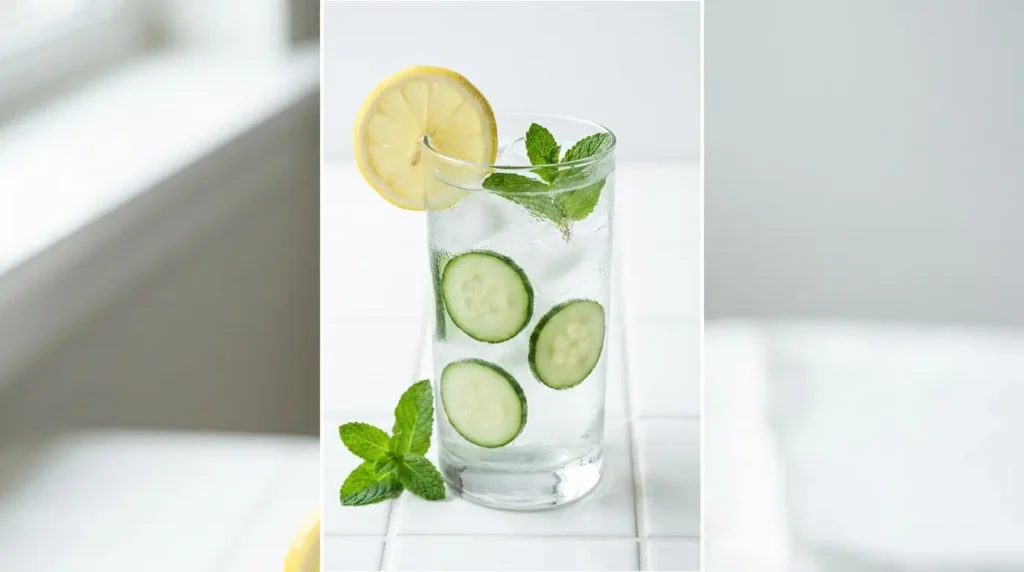
Best for: an all-purpose daily default
This is really recipes #1 and #2 combined into one pitcher: lemon’s pectin, cucumber’s mild anti-inflammatory silica, and mint’s digestive ease. It’s the one most people picture when they hear “infused water,” and in our own testing it’s also the one that held up best in the fridge over a full 48 hours without turning bitter or flat — a reasonable pick if you only want to keep one combination stocked at all times.
- ½ medium lemon, thinly sliced
- ¼ medium cucumber, thinly sliced
- 10 fresh mint leaves
- 32 oz cold filtered water
- Optional: ½ lime, sliced
How to make it: Layer all three ingredients into the pitcher, gently press the mint, fill with cold water, and refrigerate 2–4 hours.
32 oz batch · ~5 kcal · ~1g carbs · 0g protein/fat · chill 2–4 hrs
7. 🍊 Orange-Ginger-Turmeric Infused Water
Best for: inflammation support
The most heavily studied compound on this entire list is turmeric’s curcumin, and chronic low-grade inflammation is a genuine, if underappreciated, driver of stalled weight loss for a lot of people. Orange adds hesperidin — a flavonoid studied for its relationship to abdominal fat — plus vitamin C, which your body needs to make carnitine, the molecule that shuttles fat into cells to be burned. One real catch: curcumin on its own absorbs poorly. A well-known (if small and often-cited) 1998 human study found that a pinch of black pepper’s piperine dramatically increased curcumin’s bioavailability; more recent research is mixed on how much that holds up across different curcumin formulations, but it’s still worth the pinch.
- 1 medium navel orange, thinly sliced
- 1-inch fresh turmeric root, peeled and sliced (or ¼ tsp ground turmeric)
- ½-inch fresh ginger root, sliced
- 32 oz cold filtered water
- Optional: small pinch of black pepper
How to make it: Add the orange, turmeric, and ginger to your pitcher, stir in the pepper if using, and fill with water. Refrigerate 4–6 hours. The water turns a warm golden color from the curcumin — that’s normal and expected.
32 oz batch · ~8 kcal · ~2g carbs · 0g protein/fat · chill 4–6 hrs
8. 🫐 Blueberry-Lavender Infused Water
Best for: stress and cortisol, not calories
This one targets a driver of weight gain most recipes ignore: elevated cortisol. Chronic stress raises cortisol, which is linked to abdominal fat storage and carbohydrate cravings. Blueberries contain pterostilbene, shown in animal research to lower cortisol; lavender’s linalool has real, well-documented calming effects, though most of that evidence comes from aromatherapy rather than drinking it — the oral-intake research is thinner. Either way, it’s a pleasant, low-risk way to wind down in the evening.
- ½ cup fresh blueberries, gently crushed
- 4–5 fresh food-grade lavender sprigs (or 1 tsp dried culinary lavender in a muslin bag)
- 32 oz cold filtered water
- Optional: ½ lemon, sliced
How to make it: Crush the blueberries to break the skin, add the lavender, fill with water, and refrigerate 3–4 hours. Strain before drinking if you used loose dried lavender.
32 oz batch · ~7 kcal · ~2g carbs · 0g protein/fat · chill 3–4 hrs
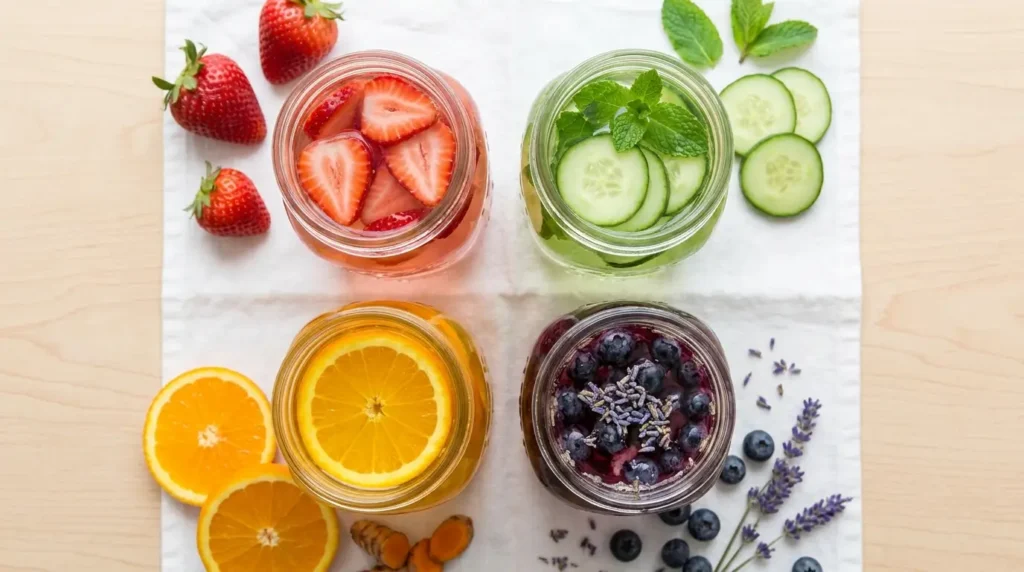
9. 🍋 Raspberry-Lemon-Rosemary Infused Water
Best for: a caffeine-free afternoon lift
Rosemary doesn’t get enough credit outside the spice rack — its 1,8-cineole compound is associated with better memory and alertness in human studies. Add raspberry’s ellagic acid and lemon’s trace electrolytes, and you’ve got a genuinely decent stand-in for a mid-morning coffee drink, calorie count alone being the obvious win.
- ½ cup fresh raspberries, lightly crushed
- 2 fresh rosemary sprigs
- ½ medium lemon, thinly sliced
- 32 oz cold filtered water
How to make it: Crush the raspberries in the bottom of the pitcher, add the rosemary and lemon, fill with water, and refrigerate 2–4 hours.
32 oz batch · ~8 kcal · ~2g carbs · 0g protein/fat · chill 2–4 hrs
10. 🍍 Pineapple-Ginger Infused Water
Best for: bloating after a protein-heavy meal
Pineapple’s bromelain is a real enzyme that helps break down protein in the digestive tract, which is part of why this combination is popular after big protein meals. Ginger speeds up gastric emptying, so food moves through faster. Add a couple of thin jalapeño slices if you want a capsaicin kick — start small, since it’s much easier to add heat than to take it away.
- ½ cup fresh pineapple chunks
- 1-inch fresh ginger root, peeled and sliced
- 32 oz cold filtered water
- Optional: ¼ jalapeño, sliced (for a thermogenic kick)
How to make it: Add the pineapple and ginger to your pitcher, fill with cold water, and refrigerate at least 2 hours.
32 oz batch · ~9 kcal · ~2g carbs · 0g protein/fat · chill 2+ hrs
11. 🍑 Peach-Basil Infused Water
Best for: a lighter summer antioxidant boost
Peaches bring beta-carotene and vitamin C, two antioxidants that work well together against oxidative stress. Basil’s eugenol adds anti-inflammatory support and a savory note that keeps this from tasting like candy. Also one of the better overnight-infusion candidates on this list — the flavor is noticeably fuller by morning than after just two hours.
- 1 medium ripe peach, pitted and sliced
- 6 large basil leaves, gently torn
- 32 oz cold filtered water
- Optional: ½ lemon, sliced
How to make it: Add the peach and torn basil to your pitcher, fill with cold water, and refrigerate 2–4 hours (overnight if you can).
32 oz batch · ~8 kcal · ~2g carbs · 0g protein/fat · chill 2–4 hrs
12. 🍇 Grapefruit-Rosemary Infused Water
Best for: appetite control, with a real caveat
Grapefruit has more human evidence behind it than most fruit on this list. A 12-week trial published in the Journal of Medicinal Food found that participants who ate half a grapefruit before meals lost significantly more weight than a placebo group — a modest effect, on the order of a few pounds over 12 weeks, attributed partly to naringenin, a compound that activates a fat-metabolizing cellular receptor. Rosemary adds the same alertness-linked compounds as recipe #9.
Important: if you take statins, certain blood pressure medications, or psychiatric medications, talk to your doctor before making grapefruit a daily habit. Compounds in grapefruit called furanocoumarins interfere with an enzyme (CYP3A4) that metabolizes many common drugs, which can meaningfully change how much medication ends up in your bloodstream.
- ½ large grapefruit, thinly sliced
- 2 fresh rosemary sprigs
- 32 oz cold filtered water
- Optional: ½ lemon, sliced
How to make it: Add the grapefruit and rosemary to your pitcher, fill with water, and refrigerate 2–4 hours — overnight for the fullest naringenin extraction.
32 oz batch · ~9 kcal · ~2g carbs · 0g protein/fat · chill 2–4 hrs
13. 🥭 Mango-Chili-Lime Infused Water
Best for: the most genuinely thermogenic recipe here
Capsaicin, the compound that makes chili peppers hot, is one of the few food compounds with real, replicated evidence for a modest boost in calorie burn — most estimates land around an extra 50–100 kcal a day with consistent intake, a real but unspectacular number. Mango adds mangiferin, a polyphenol studied for its role in fat-cell differentiation, and lime contributes vitamin C. Start with less chili than you think you need; you can always add more.
- ½ cup fresh mango, peeled and diced
- ½ medium lime, thinly sliced
- 2–3 thin slices fresh red chili (or ¼ tsp cayenne pepper)
- 32 oz cold filtered water
- Optional: small handful of fresh cilantro
How to make it: Add the mango, lime, and chili to your pitcher, fill with cold water, and refrigerate 2–3 hours.
32 oz batch · ~9 kcal · ~2g carbs · 0g protein/fat · chill 2–3 hrs
14. 🍒 Tart Cherry-Vanilla-Mint Infused Water
Best for: a bedtime pour
Tart cherries are one of the richest natural sources of melatonin, and better sleep genuinely ties to next-day appetite-hormone balance — lower ghrelin, higher leptin. A small pilot study out of Louisiana State University (eight completers, so treat it as suggestive rather than definitive) found tart cherry juice extended sleep time by an average of 84 minutes a night compared to placebo, which is a real, statistically significant result even at that small scale. Vanilla bean adds aroma and a touch of antioxidant vanillin.
- ½ cup fresh or frozen tart (Montmorency) cherries, pitted and halved
- ½ vanilla bean, split lengthwise (scrape the seeds into the water)
- 8–10 fresh mint leaves
- 32 oz cold filtered water
How to make it: Add the cherries, scraped vanilla bean and seeds, and mint to your pitcher, fill with water, and refrigerate at least 4 hours, ideally overnight. Drink 1–2 cups 30–60 minutes before bed.
32 oz batch · ~8 kcal · ~2g carbs · 0g protein/fat · chill 4–8 hrs
15. 🥝 Kiwi-Cucumber-Lemon Infused Water
Best for: vitamin C and digestive regularity
One medium kiwi covers well over 100% of a day’s vitamin C, which matters here because vitamin C is a required building block for carnitine — the transporter that moves fat into your cells’ mitochondria to be burned. Without enough of it, fat oxidation is genuinely limited at the biochemical level. Kiwi also brings actinidin, a protein-digesting enzyme, and prebiotic fiber that feeds gut bacteria linked to better metabolic outcomes.
- 2 medium kiwis, peeled and thinly sliced
- ¼ medium cucumber, thinly sliced
- ½ medium lemon, thinly sliced
- 32 oz cold filtered water
- Optional: 5–6 fresh mint leaves
How to make it: Add the kiwi, cucumber, and lemon to your pitcher, add mint if using, fill with cold water, and refrigerate 2–4 hours.
32 oz batch · ~8 kcal · ~2g carbs · 0g protein/fat · chill 2–4 hrs
16. 🫐🍋 Blackberry-Sage Infused Water
Best for: the most “grown-up” flavor on the list
Blackberries have one of the highest antioxidant densities of any common berry, and their anthocyanins are particularly good at limiting lipid peroxidation — the process by which free radicals damage fat cells and drive inflammation. Sage has a long history in traditional medicine for hormonal balance, and some newer research points to phytoestrogenic compounds that may support estrogen metabolism, which is worth knowing if you’re navigating perimenopause or PCOS-related weight changes. It’s also just less sweet than most of the others here, which some testers preferred.
- ½ cup fresh blackberries, gently crushed
- 4–5 fresh sage leaves
- ½ medium lemon, sliced
- 32 oz cold filtered water
How to make it: Crush the blackberries to release their anthocyanins, add the sage and lemon, fill with water, and refrigerate 3–4 hours. The deeper the purple, the more anthocyanin made it into the water.
32 oz batch · ~7 kcal · ~2g carbs · 0g protein/fat · chill 3–4 hrs
Quick-Reference: Recipes by Goal
| Goal | Best Recipe(s) |
|---|---|
| Reduce bloating | Cucumber-Mint (#2), Pineapple-Ginger (#10), Lemon-Cucumber-Mint (#6) |
| Metabolism support | Lemon-Ginger (#1), Mango-Chili-Lime (#13), Apple-Cinnamon (#4) |
| Appetite control | Lemon-Ginger (#1), Grapefruit-Rosemary (#12) |
| Sleep support | Tart Cherry-Vanilla-Mint (#14) |
| Stress / cortisol support | Blueberry-Lavender (#8), Blackberry-Sage (#16) |
| Post-workout recovery | Watermelon-Mint (#5) |
| Anti-inflammation | Orange-Ginger-Turmeric (#7), Strawberry-Basil (#3) |
| Energy without caffeine | Raspberry-Lemon-Rosemary (#9) |
| Digestive health | Kiwi-Cucumber-Lemon (#15), Pineapple-Ginger (#10) |
5 Tips for Getting the Most Out of Infused Water
1. Drink 16 oz (500 mL) 20–30 minutes before meals. This is the single most evidence-backed way to use water as a weight-management tool — see the study above. Use your infused water for this window specifically, rather than sipping it randomly through the day.
2. Replace your highest-calorie daily drink first. The math is simple: swap a 240-calorie coffee-shop drink for infused water three times a week, and you’ve cut roughly 720 calories — about a pound of fat a month from that one change alone.
3. Batch-prep on Sunday. Two 32 oz jars of different recipes takes about 15 minutes total. Keep one in the office fridge and one at home so there’s always something ready to grab, which removes the decision fatigue that tends to send people back to sugary drinks.
4. Add chia seeds if you want more staying power. One tablespoon of chia seeds in any of these recipes adds about 5g of soluble fiber per serving and turns a simple infused water into something that actually slows digestion and extends fullness. If you want to try the fiber-forward version of this idea on its own, we broke down whether the viral “internal shower” chia water trend actually holds up, with ratios and a safety note on properly hydrating the seeds first.
5. Spread your intake across the day. Your kidneys can only process roughly 0.8–1 liter of water per hour, so sipping 32 oz over 2–3 hours does more for cellular hydration than chugging the same amount at once. A simple pattern: one pitcher in the morning, one in the afternoon, and something calmer — like the tart cherry recipe above — in the evening.
How Infused Water Compares to Other Weight-Loss Drinks
Infused water is one of the lowest-risk, most accessible options in this whole category. Here’s how it stacks up against the other drinks people usually ask us about — and if you want the full rundown on trends beyond this list, from the pink salt trick to protein coffee, our honest breakdown of which viral weight-loss drinks actually work covers the rest of them.
| Drink | Calories | Stimulants | Evidence Level | Best Use Case |
|---|---|---|---|---|
| Infused water | 2–10 kcal | None | Moderate (primarily via hydration research) | All-day hydration, habit building |
| Lemon water | ~5 kcal | None | Moderate | Morning routine |
| Green tea | ~2 kcal | Caffeine | Strong (EGCG meta-analyses) | Morning / afternoon |
| Apple cider vinegar drink | ~5 kcal | None | Moderate | Pre-meal |
| Chia water | ~60 kcal | None | Moderate–Strong | Morning / pre-meal |
| Protein smoothie | 200–350 kcal | Varies | Strong | Meal replacement |
Curious whether apple cider vinegar’s popular “pre-meal” timing actually changes anything? We looked at whether ACV timing actually matters — short version: the drink matters more than the clock.
Frequently Asked Questions
Most batches stay good for 24–48 hours refrigerated. Pull the fruit out after 12 hours to avoid fermentation (citrus is the exception and can stay in longer). Herbs can turn bitter after 12–18 hours, so for the best flavor, make fresh batches daily.
Not inherently — plain water offers the same core benefits. Infused water’s real edge is that it gets people who find plain water boring to drink more of it, and that increased total intake is where the benefit actually comes from.
Most batches run under 10 calories per 32 oz, which is unlikely to meaningfully break an intermittent fast physiologically. If you’re following a strict or medically supervised fasting protocol, plain water is still the safest default — check with your provider.
You can. It’s still nutritious, just softer, since much of its water-soluble content has steeped out. Strawberries, raspberries, and blueberries are pleasant to eat afterward; citrus and cucumber tend to turn slightly bitter.
Yes — and it can actually infuse faster, since the freeze-thaw process ruptures cell walls and releases juice more quickly. Frozen berries in particular can be ready in 30–45 minutes versus 2–3 hours for fresh.
Only in small amounts — citrus contributes trace potassium, cucumber contributes trace magnesium. For meaningful electrolyte content around exercise, add a small pinch of pink Himalayan salt and a squeeze of lime to any recipe above.
The Bottom Line
None of these sixteen recipes are magic. What they actually do is turn “drink enough water” from a chore into something you look forward to, replace higher-calorie drinks by default, and give you consistent, low-level exposure to compounds — gingerols, polyphenols, digestive enzymes — that support the metabolic and digestive conditions that make fat loss a little easier. That’s a real, worthwhile effect. It’s just a habit-building one, not a shortcut.
Start with one recipe this week: cucumber-mint if bloating is your main complaint, lemon-ginger if you want appetite support, or tart cherry-mint if sleep is the piece you’re missing. Once you’ve got a daily infused water habit locked in, the next practical question is simple — how much water should you actually be drinking? That’s worth reading next.
Every recipe on this page was batch-prepped and taste-tested in the DrinkFitLab kitchen by Mabel Winslow before publishing. It’s written for educational purposes and isn’t a substitute for medical advice — talk to a registered dietitian or your doctor before making significant changes to your diet, particularly if you take medications (see the grapefruit note in Recipe #12) or manage a medical condition.
Keep exploring DrinkFitLab’s hydration guides:
- How Much Water Should You Drink to Lose Weight? — practical daily targets instead of a generic rule
- Does Drinking Water Actually Help You Lose Weight? (Evidence) — the mechanisms, honestly explained
- The 7-Day Lemon Water Challenge: Honest Results & What to Expect — a realistic day-by-day breakdown
- Chia Seed Water for Weight Loss: Does the “Internal Shower” Work? — fiber-first hydration that keeps you full longer
- Pink Drink for Weight Loss: 5 Recipes Ranked by Calories — for more colorful, photogenic options